
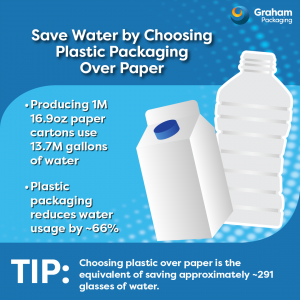
Did you know choosing plastic over paper is the equivalent of saving approximately 291 glasses of water?
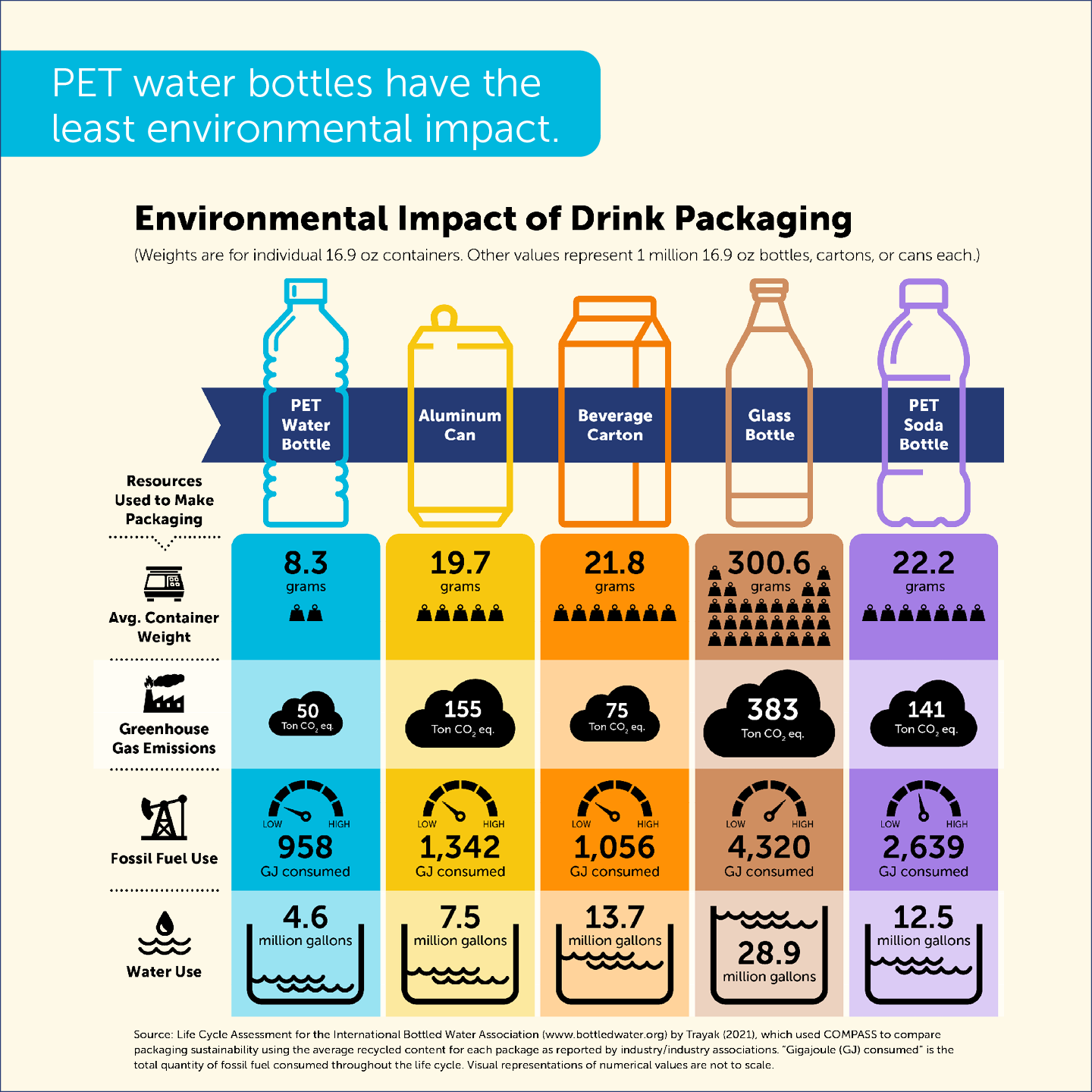
Source: Life Cycle Assessment for the International Bottled Water Association
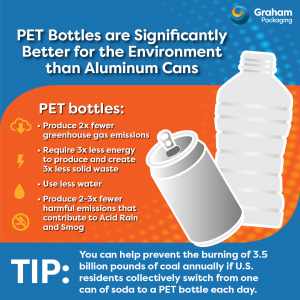
Did you know that PET bottles are significantly better for the environment than aluminum cans?
PET bottles require three times less energy to produce and create three times less solid waste.
The more you know!
*Source: NAPCOR
Lancaster, Pa — (August 30, 2023) — Graham Packaging, a global leader in sustainable packaging solutions, is proud to announce its certification under GreenBlue’s Recycled Material Standard (RMS). Graham stands as the first company in the United States to implement multi-site certification for mass balance under the RMS, a reflection of its unwavering commitment to sustainability and its dedication to promoting the use of recycled materials in its products.
RMS establishes robust requirements, ensuring the accuracy and transparency of claims through a rigorous third-party certification system. Graham’s journey towards RMS certification began with a successful pilot program in 2022, conducted in partnership with GreenBlue. This pilot program enabled Graham to pursue multi-site certification under the RMS, leveraging the mass balance methodology to transfer PCR credits across its diverse product portfolio, helping its customers achieve their own PCR goals. Mass balance methodology is a tracking system that allows companies to account for the use of certified materials throughout their supply chains by balancing the purchase and sales of materials. It enables companies to make claims about the use of certified materials without requiring every individual product to contain those materials.
“This certification empowers us to incorporate higher levels of post-consumer recycled content, delivering sustainable packaging solutions to our customers,” said Tracee Auld, chief strategy and sustainability officer of Graham. “The traceability, third-party verification, and flexibility provided by the RMS are invaluable tools that reinforce Graham’s commitment to transparency and environmental responsibility.”
Graham has set ambitious sustainability goals, one of which is to incorporate an average of 20% post-consumer recycled content (PCR) across all its manufactured bottles by 2025. With the RMS certification, the company can optimize the utilization of PCR in its products while ensuring accurate tracking and accountability of all recycled materials. This flexibility is particularly crucial in assisting its customers in meeting their targets for the use of recycled materials in food-grade applications, where the supply can be limited. The RMS certification covers two of Graham Packaging’s facilities: its flagship manufacturing facility and Graham Recycling Company, both located in York, Pennsylvania.
“Our collaboration with RMS and GreenBlue exemplifies Graham’s steadfast commitment to advancing sustainability practices and fostering a more circular economy,” said Richa Desai, Vice President of Sustainability at Graham Packaging. “Together, we are actively shaping a future where recycled materials play a pivotal role in minimizing environmental impact and creating a better tomorrow.”
To learn more about Graham’s sustainability initiatives, please visit www.grahampackaging.com/sustainability.
Graham Packaging is committed to reducing greenhouse gas (GHG) emissions and energy use across all aspects of its operations. The company has implemented a five-pronged strategy that includes reducing energy intensity, sourcing renewable energy, increasing the use of post-consumer recycled (PCR) materials, lightweighting bottles, and collaborating with suppliers to reduce GHG emissions.
The need for GHG emissions reduction cannot be overstated. The world is facing a climate crisis, and GHG emissions are one of the primary drivers of this crisis. The Intergovernmental Panel on Climate Change (IPCC) has warned that if global temperatures rise more than 1.5°C, the consequences will be catastrophic. The effects of climate change can already be seen in the form of extreme weather events, sea level rise, and other natural disasters.
Graham understands the seriousness of the situation and has taken concrete steps to reduce our GHG emissions. We have established targets in line with 1.5°C based on the latest climate science, and recently earned approval by the Science-Based Targets Initiative (SBTi). With approval by SBTi, we are committing to reducing our absolute scope 1, 2 and 3 GHG emissions 30% by the end of 2030 from a 2020 base year.
Work has already begun to hit that target. In fact, in 2022, Graham saw a 6% reduction in overall GHG emissions from its 2020 baseline. The key reasons our GHG emissions were reduced compared to the previous year were that the company reduced its total energy consumption by 3%, sourced 4% of its global electricity from renewable sources, used lower volume of resin and had an average of 7% PCR across our products.
To achieve our GHG emissions reduction target, Graham is implementing several initiatives. One of the primary focuses of the company is to reduce our energy intensity. Graham understands the energy demands of manufacturing and has identified opportunities to address energy inefficiency. Our teams developed and implemented automated grinder and blower controls at several plants, which allows plants to design potential soft/staggered starts and idle machines when not needed without manual intervention. Graham is also exploring innovations like ceramic oven reflectors in its heating systems, which can reduce oven power consumption by 10-20%, and automated compressed air controller solutions.
Another initiative that Graham is pursuing is the sourcing of renewable energy. The company has collaborated with suppliers and customers to drive efficiency and reduce emissions. Our dedicated team members have managed renewable-energy contracts and monitored performance to achieve the milestone of operating all of Graham’s plants in Brazil and in Aldaia, Spain solely on renewable energy.
The company is also committed to increasing the use of post-consumer recycled (PCR) materials. The use of PCR materials reduces the carbon footprint of the packaging by reducing the amount of virgin resin used. We have already made significant progress in this area, and the company is working towards using more PCR materials in the future.
Graham is continuing to lightweight bottles to reduce the amount of resin used in its products. By using less resin, we can reduce our carbon footprint while maintaining the quality and performance of our products.
Finally, Graham is collaborating with its suppliers to reduce GHG emissions. We recognize that we can’t do this alone, and as part of a larger value chain, we’re working to create a positive impact across the value chain.
Graham Packaging is committed to reducing GHG emissions and energy use across all aspects of our operations. The company’s innovative approach to addressing energy inefficiency and collaboration with suppliers and customers has helped to reinforce its position as a leader in sustainability. With a clear strategy in place and a commitment to implementing innovative solutions, we know that Graham is well on its way to achieving its ambitious GHG emissions reduction goals.
Lancaster, Pa — (May 31, 2023) — Graham Packaging, a leader in sustainable packaging, announced today that the Science-Based Targets initiative (SBTi), a global body made up of leading climate organizations, has approved the company’s 2030 absolute emissions reduction targets. This validation reaffirms Graham’s target to reduce its absolute scope 1, 2 and 3 emissions as set out in its ESG strategy.
SBTi establishes a clearly defined pathway for companies to reduce greenhouse gas (GHG) emissions to levels necessary to meet the goals of the Paris Agreement — reduce GHG emissions to limit the global temperature increase in this century to 2°C while pursuing efforts to limit the increase even further to 1.5°C. With approval by SBTi, Graham is committing to reducing its absolute scope 1, 2 and 3 GHG emissions 30% by the end of 2030 from a 2020 base year.
“We are pleased to have our GHG emissions reduction target approved by SBTi,” said Bob Pyle, President and Chief Executive Officer of Graham Packaging. “This milestone underscores our company’s unwavering commitment to sustainability and reducing our impact on the environment. By setting ambitious targets in line with the latest climate science, we are taking decisive action to address the urgent challenge of climate change. By gaining this validation, we hope to continue to support our customers to achieve their own sustainability goals while fostering a more resilient future for all.”
Along with target development, Graham has also created a strategy to enable target achievement. That plan continues Graham’s work in reducing emissions through lightweighting technologies, increased PCR incorporation and improved energy efficiency—including the use of renewable energy. Graham also encourages its suppliers to reduce their GHG emissions, creating a positive impact across its value chain. Thanks to these efforts and more, in 2022 the company saw a 6% reduction in GHG emissions from baseline.
“Our goal of reducing our absolute GHG emissions by 30% by the end of 2030 is an important step towards achieving our Strategy for a Better Tomorrow,” said Tracee Auld, Chief Strategy and Sustainability Officer. “We are proud to be a leader in our industry and look forward to continuing to drive meaningful progress towards a more sustainable world.”
To learn more about Graham’s sustainability initiatives, please visit www.grahampackaging.com/sustainability.
About the Science Based Targets initiative
The Science Based Targets initiative (SBTi) is a global body enabling businesses to set ambitious emissions reductions targets in line with the latest climate science. It is focused on accelerating companies across the world to halve emissions before 2030 and achieve net-zero emissions before 2050.
The initiative is a collaboration between CDP, the United Nations Global Compact, World Resources Institute (WRI) and the World Wide Fund for Nature (WWF) and one of the We Mean Business Coalition commitments. The SBTi defines and promotes best practices in science-based target setting, offers resources and guidance to reduce barriers to adoption, and independently assesses and approves companies’ targets. www.sciencebasedtargets.org @sciencetargets
About Graham Packaging
Founded in 1970, Graham Packaging is a global leader in the development and design of creative, sustainable packaging solutions for a variety of industry-leading consumer brands. The company employs some of the best and brightest package designers, who bring inspired, technology-driven solutions to market. Headquartered in Lancaster, Pennsylvania, with a flagship manufacturing facility in nearby York, Pennsylvania, Graham Packaging produces approximately 16 billion containers annually across nearly 65 plants in North America, Europe and South America. For additional information on Graham Packaging, please visit https://www.grahampackaging.com/.
Graham Packaging was ranked in the top 2% of the more than 15,600 global companies assessed by Sustainalytics in its latest Environmental, Social and Governance (ESG) Rating. The company also received second in its containers and packaging industry category and second in its subindustry of metal and glass packaging.
In addition, Graham Packaging has been recognized as a Morningstar Sustainalytics ESG Industry Top Rated company in 2022, as well as an ESG Regional Top Rated Company.
“We are very pleased with our strong ESG Risk Rating, which demonstrates our commitment to building a sustainable future,” said Bob Pyle, president and chief executive officer of Graham Packaging. “Being a top-rated ESG company validates our sustainability efforts to our major stakeholders, including our customers, shareholder and employees. Graham is proud to be a people, planet and values-based company that is dedicated to creating a better tomorrow.”
Sustainalytics’ ESG Risk Ratings measure a company’s exposure to industry-specific material ESG risks and how well a company is managing those risks. This multi-dimensional way of measuring ESG risk combines the concepts of management and exposure to arrive at an assessment of ESG risk that is comparable across all industries. Sustainalytics’ ESG Risk Ratings distinguish between five levels of risk: negligible, low, medium, high and severe, with a lower score equating to a better risk assessment. Graham Packaging received a low-risk rating of 10.3.
“Our ESG Risk Rating shows Graham’s commitment to finding new ways to support our people and our planet,” said Tracee Auld, chief strategy and sustainability officer at Graham. “We continue to make progress on many of our goals, refining our approach and renewing our commitment to true environmental, social and ethical responsibility.”
“Graham has worked hard to look at the full value chain,” added Richa Desai, vice president of sustainability. “From aligning with the science of climate change, to improving traceability and transparency and ensuring a diverse and inclusive work environment – we are championing initiatives that will help us build a more sustainable future.”
In addition to its low-ESG-Risk Rating, Graham Packaging also received high scores for its risk management, which was double the industry average. This reflects how well Graham manages its relevant ESG issues and assesses the robustness of our sustainability programs, practices and policies.
To learn more about Graham Packaging’s sustainability efforts, please visit https://www.grahampackaging.com/sustainability.