
In addition to being very widely recyclable and easy for consumers to recycle, blow molded plastic containers offer these benefits:
-
- Customizable shape and color for brand differentiation
- Versatile for a wide range of food and non-food applications
- Produced with little to no process waste
- Durable and lightweight for distribution
- Display perfectly on retail shelves
- Convenient to open, dispense, reclose and store
- Easy to recycle, in high demand in recycling markets and can utilize up to 100% post-consumer recycled content
- Favorable EPR fees compared to alternative pack types
We are the plastic packaging experts!
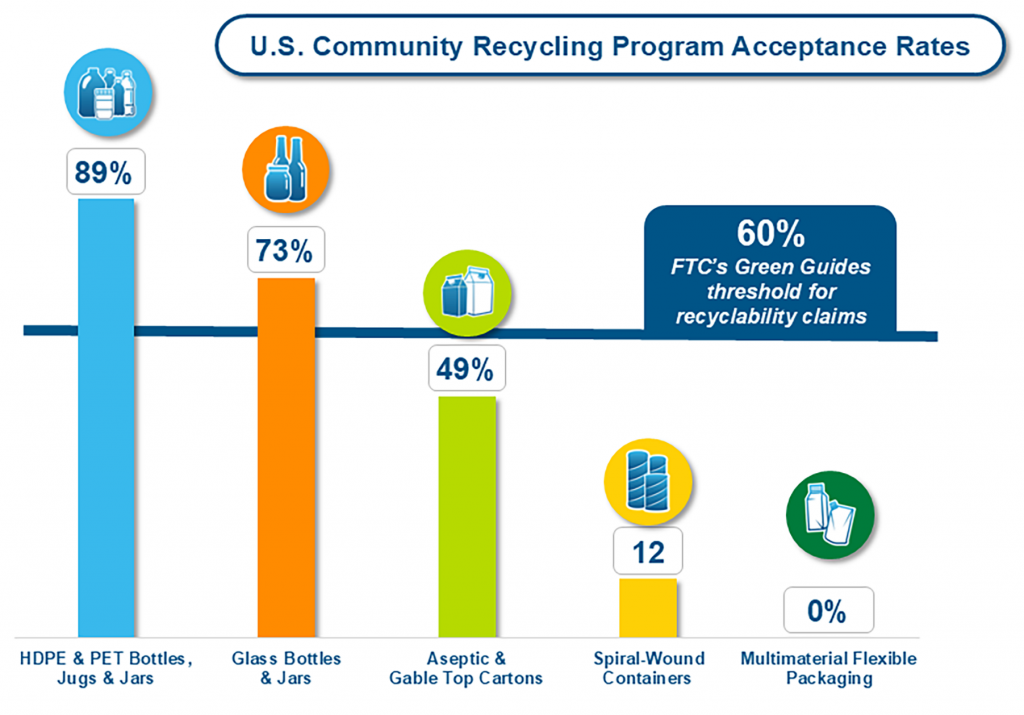
As brands navigate the evolving landscape of sustainable packaging, the debate between rigid plastic bottles and aseptic and gable top cartons is worth looking at more closely. While these types of cartons have long been marketed as the eco-friendly choice, recent data and regulatory developments suggest that plastic packaging offers a more practical and scalable path forward.
What California’s “Truth in Labeling” Law (SB 343) Actually Means
California’s SB 343 sets strict criteria for what can legally be labeled “recyclable.” In August 2025, CalRecycle updated its Material Characterization Study, confirming that aseptic and gable top cartons now meet the 60% sortation threshold, up from 47%. This means they technically qualify under California’s collection and sortation requirements.
However, CalRecycle does not determine recyclability claims—that’s a legal decision for each company and its counsel. And while How2Recycle currently lists aseptic and gable top cartons as “Widely Recyclable,” the Recycling Partnership’s 2025 data shows national acceptance at only 49%, well below the 60% threshold. If rates don’t improve by 2026, aseptic and gable top cartons will be downgraded to “Check Locally,” creating confusion and compliance risk for brands.
Consumer Preference: Bottles Win on Convenience
According to Mintel’s 2025 Global Consumer Trends, consumers increasingly prioritize convenience, clarity and authenticity in packaging. Plastic bottles are:
- Easy to recycle curbside;
- Portable and resealable; and
- Trusted by consumers for everyday use.
While aseptic and gable top cartons may appear sustainable, their limited recycling access and lack of transparency make them less practical for modern shoppers.
True Recycling at Scale
Rigid plastics like PET and HDPE are:
- Widely accepted by over 89% of U.S. recycling programs;
- Efficiently processed into new bottles and products; and
- Compatible with existing infrastructure, unlike aseptic and gable top cartons, which require specialized facilities.
This means plastic bottles offer real circularity, not just theoretical recyclability.
Environmental Impact in Practice
Plastic packaging continues to evolve.
- Lightweighting reduces material use and emissions.
- High PCR content helps brands meet circularity goals.
- Label-less and mono-material designs improve sortation and reduce contamination.
Aseptic and gable top cartons, by contrast, are often downcycled into wallboard or insulation, limiting their sustainability potential.
Performance & Versatility
Rigid plastics offer:
- Superior barrier properties for moisture, oxygen and light;
- Longer shelf life and better product protection; and
- Design flexibility for branding and consumer experience.
These advantages are especially critical in categories like nutritional beverages, where product integrity and shelf stability are non-negotiable.
Bottom Line: Aseptic and gable top cartons may now meet the minimum threshold, but plastic bottles exceed expectations—in recyclability, performance and consumer trust.
At Graham, we strive to be responsible, purposeful and sustainable across every facet of our business and that commitment extends to our customers, the communities we operate in, and our planet. By offering a range of targeted services, we can collaborate in a way that benefits our environment while creating value for our customers and ourselves.
Decarbonization Roadmapping
A decarbonization roadmap is a strategic sustainability plan that outlines specific actions, milestones and timelines for reducing greenhouse gas emissions. This plan identifies and quantifies the levers to achieve decarbonization targets, which can include strategies such as:
- Incorporating post-consumer resin (PCR) into products in place of virgin material.
- Implementing energy efficiency projects to reduce overall energy demand that, in turn, lowers carbon emissions from fossil fuel combustion.
- Collaborating with our supply chain to reduce the carbon footprint of the raw materials we purchase.
- Utilizing lightweighting technologies (like Graham’s AccuStrength® or Active Base innovations) that optimize a package’s design using the least amount of material to lower the overall carbon footprint across the supply chain.
- Leveraging sustainable material innovations, like plastics made with renewable inputs.
The process allows us to identify and address any gaps as we work towards our collective greenhouse gas reduction goals.
Life Cycle Assessment (LCA)
A Life Cycle Assessment is a method for evaluating the impact a product has on the environment over its entire life cycle, giving our customers insights into the impact of their packaging from manufacturing through shipping and end-of-life disposal.
This assessment allows us to help customers quantitatively identify where they can make changes to their packaging that will have the biggest impact on its environmental performance. The LCA looks at metrics such as fossil fuel use, water consumption, freshwater eutrophication and global warming potential.
The benefits of conducting an LCA on your products include:
- Reduction of carbon footprint and environmental impact
- Alignment with sustainability goals and regulatory requirements
- Stronger brand perception among environmentally-conscious consumers
- EPR fee reductions through eco-modulation incentives
Following the LCA, our dedicated sustainability experts will work with you to interpret the findings and implement practical, high-impact changes to enhance the sustainability of your package and drive meaningful change for your business and the environment.
Expertise in PCR
Graham has been at the forefront of PCR sourcing beginning 35 years ago with the opening of our mechanical recycling facility, Graham Recycling Company (GRC). Located in York, PA, GRC recycles #2 HDPE bottles into PCR and has grown to become a leading supplier of bottle-grade recycled plastics containers in North America.
Beyond our in-house capabilities, our expert procurement team is dedicated to finding new ways to increase our supply of recycled material and meet the growing demand for PCR. Additionally, our ISCC Plus certified sites help ensure supply chain transparency and reliability.
Design for Recyclability
At Graham, designing for recyclability is a cornerstone of our sustainability strategy—one that’s backed by over 50 years of innovation. We integrate recyclability into every stage of the packaging lifecycle, from material selection and structural design to performance testing and end-of-life considerations. Our team prioritizes widely recycled plastics like PET and HDPE and develops lightweight, space-efficient designs that reduce material use and enhance freight efficiency.
By leveraging advanced technologies such as finite element analysis (FEA) and CT scanning, we validate performance while optimizing for recycling processes. Collaboration across engineering and manufacturing ensures our solutions meet both functional and sustainability goals, creating packaging that is durable, recyclable and responsible.
Ready to take the next step in your sustainability journey? Our sustainability team is here to help you identify opportunities, navigate evolving regulations and implement impactful packaging solutions tailored to your business goals.
Whether you’re just getting started or looking to deepen your commitment to sustainable practices, we invite you to connect with us and explore how Graham can support your success.
Did you know, according to the EPA, every year between Thanksgiving and New Year’s, Americans generate an estimated 25% more waste? This Thanksgiving let’s show gratitude not just for the people around us, but also for our planet.
By making a few mindful choices, we can celebrate the season sustainably.
Recycle as much as you can, especially #1 (PET), #2 (HDPE) and #5 (PP) plastics: When it comes to recycling, the following types are considered widely recyclable:
- #1 plastics such as water and soda bottles and peanut butter jars.
- #2 plastics such as milk jugs, detergent containers and shampoo bottles.
- #5 plastics such as yogurt containers, syrup bottles and margarine tubs.
To encourage recycling at your gathering, consider making a sign for your recycling bin detailing what items are accepted, and be sure to only put clean, dry materials into your recycling bin. To find out what items can be recycled in your area, click here.
Use reusable dinnerware. Now is the time to put that fine china and glassware to good use! Skip the disposable plates and utensils and opt for reusable ones. Additionally, using cloth napkins and tablecloths add a touch of elegance to your table while also reducing single-use waste.
Reduce food waste. The best way to reduce food waste is to plan ahead. If you are hosting a celebration, confirm headcount before you go grocery shopping, check recipe serving sizes and plan out your menu, so you only buy the ingredients you need. You can also ask guests to bring their own reusable containers for leftovers instead of using polystyrene foam.
By making these small changes, we can reduce waste and protect our planet—not just on Thanksgiving, but throughout the year.
 In today’s world, consumers and businesses are more environmentally conscious than ever before. As sustainability takes center stage in discussions around global challenges, industries are under increasing pressure to develop solutions that minimize environmental impact.
At Graham Packaging, sustainability isn’t just a buzzword—it’s a core commitment driving our operations and innovation. Our approach to creating sustainable packaging solutions reflects our dedication to reducing our environmental footprint.
Using Sustainable Materials for a Greener Future
One of the ways Graham is leading the charge in sustainable packaging is through our use of environmentally friendly materials. Our commitment to incorporating recycled content is a critical part of our sustainability strategy.
By increasing the use of recycled content in our packaging, we not only reduce our reliance on fossil fuel-based resources but also lower the overall carbon footprint of our products. Our goal is to continue to grow this effort, increasing the amount of recycled material we use each year.
Designing for Circularity
At Graham, innovation doesn’t stop at materials—we also focus on designing packaging that fits into a circular economy. This means creating products that can be easily reused, recycled or repurposed after their initial use. Through thoughtful design, we ensure our packaging helps to minimize waste and reduce the need for new raw materials. To achieve this, our packaging is carefully formulated and designed in accordance with the Association of Plastic Recyclers (APR) Design® guidelines, enhancing recyclability and compatibility with industry standards.
Our design team works to optimize the lifecycle of our packaging by considering its entire journey, from production to disposal. For example, our lightweighting initiatives focus on reducing the amount of material needed to create each package, without compromising its functionality or strength. By making packaging lighter, we reduce both the amount of plastic used and the energy required for transportation, which directly contributes to lowering emissions.
We are also developing new packaging solutions that are compatible with existing recycling systems, making it easier for consumers to responsibly dispose of their packaging. This approach not only helps to close the loop on plastic waste but also fosters a circular economy where materials are continually reused.
A Long-Term Commitment to Sustainability
As we continue to explore new ways to make our packaging more sustainable, our long-term goals drive us forward. Graham is committed to achieving 100% recyclable, reusable, or compostable packaging by 2025. This ambitious target reflects our dedication to not only meet but exceed industry standards in sustainability.
Furthermore, our collaborations with industry partners, suppliers, and consumers are critical to making progress toward a greener future. We actively participate in initiatives that promote recycling infrastructure, educate consumers about proper recycling practices, and support legislation aimed at improving sustainability in the packaging industry.
Conclusion
Graham Packaging’s leadership in sustainable packaging innovation is a testament to our commitment to reducing environmental impact. By embracing recycled materials, designing for circularity, we are actively contributing to a more sustainable future. As we continue to innovate and grow, our mission remains clear: to create packaging solutions that protect both the products they contain and the planet.
Opting for rigid plastic packaging over flexible alternatives helps ensure plastics stay within the recycling stream, allowing them to be repurposed into new products.
Source: https://www.flexpack.org/glenroy-case-studies – Chocolate Syrup Package Comparison.
